
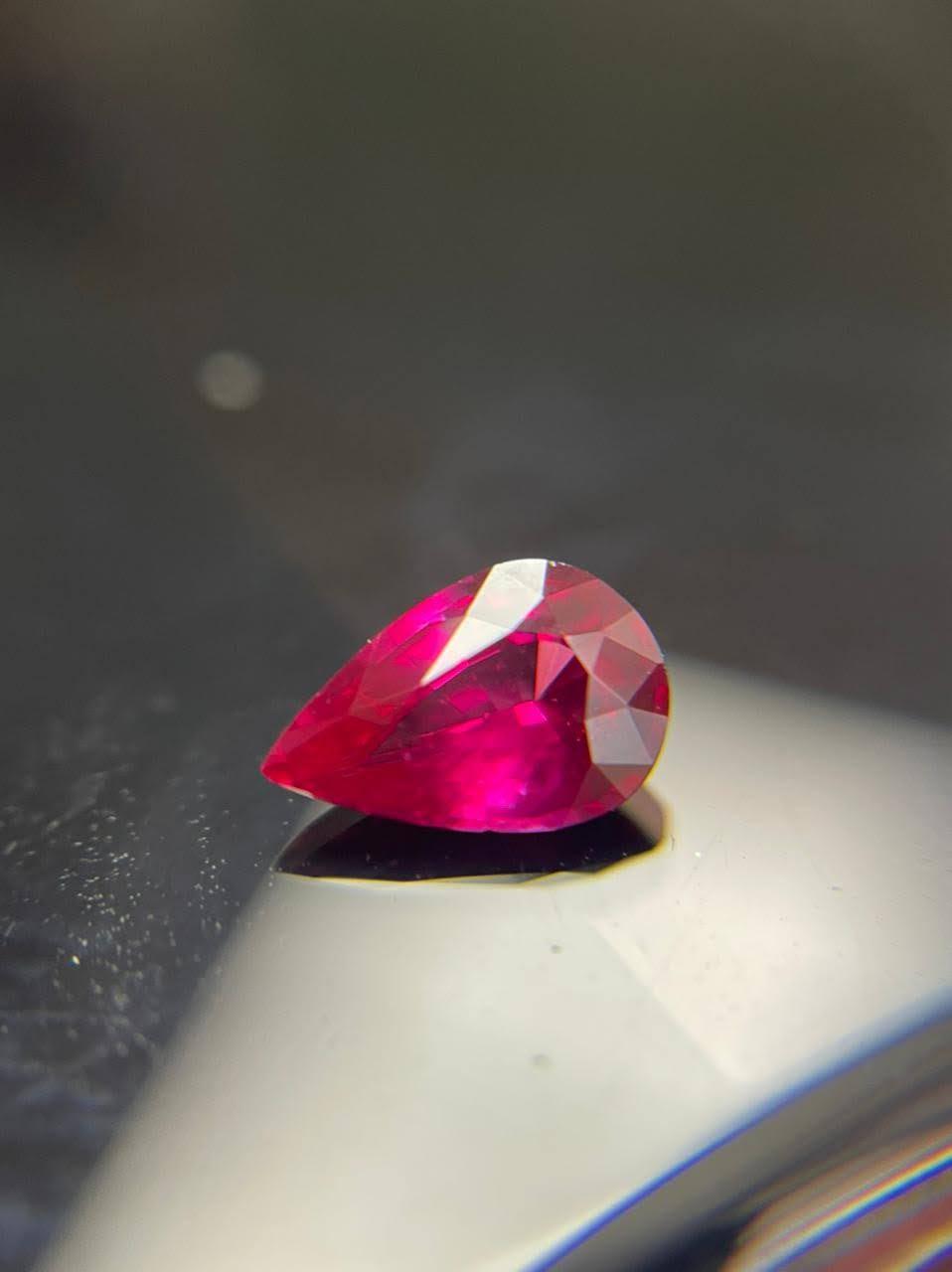
Ruby gemstone: the complete guide to natural rubies
Share
Gemstone Education
Ruby gemstone: the complete guide to natural rubies
The Colored Stone Co. · May 2026 · 9 min read
Ruby has been called the king of gemstones for millennia. Ancient Sanskrit texts name it ratnaraj — “king of precious stones.” Burmese warriors believed rubies made them invincible in battle. And today, fine natural rubies remain among the most valuable gemstones on earth — with top-quality specimens regularly outpacing diamonds in price per carat at major auctions.
This guide covers everything about ruby gemstones: what they are, where the best ones come from, the famous “pigeon blood” colour standard, the difference between natural and lab-grown rubies, how heat treatment affects value, and what to look for when choosing a ruby for jewellery.
What is a ruby?
Ruby is red corundum — the same mineral (aluminium oxide) as sapphire. The colour comes from the trace element chromium: more chromium produces deeper, more saturated red. The boundary between ruby and pink sapphire is technically defined by chromium concentration — above a certain saturation threshold, red corundum is classified as ruby; below it, as pink sapphire. In practice, the line between a fine pink sapphire and a light ruby is one that different gemological labs can disagree on.
Like sapphire, ruby rates Mohs 9 — the second hardest gemstone after diamond (Mohs 10). This makes it one of the most durable coloured gemstones for rings and daily-wear jewellery. Read more about the Mohs hardness scale and what it means for jewellery durability.
Ruby is one of the four traditional precious gemstones alongside diamond, sapphire, and emerald.
The pigeon blood colour: what it means and why it matters
“Pigeon blood” is the most celebrated colour description in the ruby world. It refers to a very specific red — a pure, vivid red with a slight blue fluorescent undertone, no orange or brown, and strong saturation that doesn’t turn dark or muddy in low light. The term originates from Burmese gem traders who observed that the finest rubies matched the colour of the first two drops of blood from a freshly killed pigeon.
Pigeon blood is not a precise scientific standard — it’s a trade descriptor, and different labs apply it with slightly different criteria. The Gübelin Gem Lab and SSEF in Switzerland were among the first to use the term formally on certificates, which significantly elevated its commercial value. A ruby certified as “pigeon blood” by a major lab commands a substantial premium over a comparable stone without the designation.
The finest pigeon blood rubies traditionally come from the Mogok Valley in Burma — a source that has been producing exceptional rubies for over a thousand years. Ceylon (Sri Lankan) rubies also achieve the pigeon blood standard in exceptional specimens, though most Ceylon rubies tend toward a slightly lighter, pinker red compared to Burmese stones.
“Pigeon blood” is a quality descriptor, not a separate variety of ruby. It’s applied at the top of the colour quality scale and typically only to Burmese-origin stones. Seeing it on a certificate from a reputable lab (GIA, Gübelin, SSEF, GRS) is a meaningful quality signal — but the origin of the certificate matters as much as the term itself.
Where do the finest rubies come from?
BURMA (MOGOK VALLEY)
Mogok is the historical gold standard for ruby. Burmese rubies are celebrated for their intense, pure red with strong chromium fluorescence — the quality that makes them glow in sunlight. Top-quality Mogok rubies are among the most valuable gemstones on earth per carat, with exceptional stones selling for USD 1 million+ per carat at international auctions.
SRI LANKA (CEYLON)
Ceylon rubies tend to be lighter in colour — often pinkish-red rather than deep red — compared to Burmese stones. They’re typically less expensive, though exceptional specimens can reach pigeon blood quality. Sri Lanka is better known for its sapphires, but Ceylon rubies have their own distinctive character and are valued for their clarity and Ceylon provenance.
MOZAMBIQUE
Mozambique has emerged as a major ruby source since the discovery of the Montepuez deposit in 2009. Mozambique rubies can achieve deep reds comparable to Burmese quality, though they typically show more iron (producing slightly darker, less fluorescent stones). They’ve largely replaced Burmese rubies in the mid-to-upper commercial market.
TANZANIA (WINZA)
Winza rubies from Tanzania are notable for their exceptional purity and clarity — unusually clean for ruby, which typically has inclusions. Winza stones are relatively rare and prized by collectors who appreciate their distinctively clean appearance.
| Origin | Colour Character | Notable For | Relative Pricing |
|---|---|---|---|
| Burma (Mogok) | Deep, pure red; strong fluorescence | Finest pigeon blood; historical prestige | Highest |
| Mozambique | Deep red; less fluorescent | Modern premium market; large supply | High |
| Sri Lanka (Ceylon) | Pinkish-red; good clarity | Ceylon provenance; accessible price | Mid-range |
| Tanzania (Winza) | Medium-deep red; unusually clean | Exceptional clarity for ruby | Mid to high (collector) |
Heat treatment in rubies: what’s normal and what’s not
The vast majority of rubies on the market — estimates range from 95–99% — have been heat treated. Heating dissolves inclusions, improves colour saturation, and clarifies the stone. This is the standard treatment for ruby, long-established in the trade, disclosed on certificates, and permanent. Heat-treated rubies are not considered inferior — they’re the norm.
Unheated rubies of fine quality are exceptionally rare. Certificates that state “no indication of heating” from major labs command a significant premium — sometimes 2–5× or more versus a comparable heat-treated stone. For collectors and investment buyers, unheated provenance is a priority. For most jewellery buyers, a well-selected heat-treated ruby delivers excellent colour and value.
A more significant distinction is between heat treatment and fracture filling — a process where lead glass or other substances fill surface-reaching fractures to improve apparent clarity. Fracture-filled rubies are significantly less valuable, require special care (heat and cleaning agents can damage the filling), and should be avoided for investment purposes. Certificates always disclose fracture filling.
Natural vs lab-grown rubies
Lab-grown rubies are chemically identical to natural rubies — the same corundum composition, the same Mohs 9 hardness. They can be produced in large quantities, which is why they’re available at a fraction of the price of natural stones. A lab-grown ruby with vivid pigeon blood colour costs a fraction of what a natural heat-treated ruby of equivalent appearance would fetch.
The distinction matters for value and resale: natural rubies of fine quality hold and appreciate in value; lab-grown rubies do not, and their price has dropped substantially as production capacity has expanded. Certificates disclose whether a ruby is natural or laboratory-grown — always verify this before purchasing.
Interested in a ruby piece?
Message us on WhatsApp to discuss ruby options — natural, certified, Sri Lanka and beyond. We can also explore our full range of certified coloured gemstones including Ceylon sapphires.
💬 Chat with Us on WhatsAppRuby vs sapphire: same mineral, very different market
Ruby and sapphire are both corundum — Mohs 9, excellent toughness, same durability for daily wear. The market treats them very differently. Fine natural rubies of top quality consistently outprice equivalent sapphires at auction. The reason: fine rubies are rarer than fine sapphires. The geological conditions that produce deep, pure red in corundum — enough chromium without excess iron — are less common than those that produce blue.
For buyers choosing between the two for a ring: both are excellent. Ruby’s red is bold and commanding; Ceylon sapphire’s colour range is wider, and fine sapphires at a given budget are typically more accessible than comparable rubies. Explore our gemstone colours guide to compare options across the full spectrum.
Frequently asked questions about ruby
What is a ruby gemstone?
Ruby is red corundum — the mineral aluminium oxide — coloured by trace chromium. It rates Mohs 9 on the hardness scale, making it one of the most durable gemstones for jewellery. Ruby is classified as one of the four traditional precious gemstones alongside diamond, sapphire, and emerald.
What is pigeon blood ruby?
Pigeon blood is a trade descriptor for the finest ruby colour — a pure, vivid red with a slight blue fluorescent undertone, no orange or brown, and strong saturation. It’s applied to top-quality stones, typically of Burmese origin, and when certified by a major lab (GIA, Gübelin, SSEF, GRS) it commands a significant price premium.
Are most rubies heat treated?
Yes — estimates suggest 95–99% of commercial rubies are heat treated to improve colour and clarity. Heat treatment is a permanent, stable, accepted standard treatment in the ruby trade and is always disclosed on certificates. Unheated rubies of fine quality are exceptionally rare and command a significant premium.
What is the difference between a natural and lab-grown ruby?
Natural rubies formed over millions of years in the earth; lab-grown rubies are chemically identical but produced in weeks in a controlled environment. Both are Mohs 9 and suitable for jewellery. Natural rubies of fine quality hold value; lab-grown rubies do not appreciate and are priced accordingly. Certificates always disclose whether a ruby is natural or lab-grown.
Is ruby or sapphire harder?
Neither — ruby and sapphire are both varieties of corundum and share exactly the same Mohs 9 hardness rating. Both are equally durable for daily wear, equally resistant to scratching, and both have excellent toughness with no cleavage. The only difference is colour: red corundum is ruby, all other colours are sapphire.
Where are the best rubies from?
The Mogok Valley in Burma (Myanmar) is the historical gold standard for the finest rubies — the source of most pigeon blood specimens and the top prices at international auctions. Mozambique has become the leading commercial source since 2009, producing deep reds at high volume. Sri Lanka (Ceylon) produces lighter, pinkish rubies with their own distinctive character and Ceylon provenance.
Looking for a certified coloured gemstone?
We work with certified natural coloured gemstones including Ceylon sapphires, rubies, and spinel. Chat with us on WhatsApp to discuss options and pricing. Ships locally and internationally.
💬 Chat with Us on WhatsApp