
Precious and semi-precious stones: the complete classification guide
Share
Gemstone Education
Precious and semi-precious stones: the complete classification guide
The Colored Stone Co. · May 2026 · 9 min read
Ask a jeweller to sort their gemstones into “precious” and “semi-precious” piles, and you’ll get an interesting answer: most of them will tell you the categories don’t really mean what they sound like. A fine Ceylon sapphire can cost more than a low-quality diamond. A padparadscha sapphire sells for multiples of what a common garnet fetches. Yet one is called “precious” and the other is not.
The classification of precious and semi-precious stones is one of the most widely used — and most misunderstood — frameworks in the gemstone world. This guide explains where the distinction comes from, what it actually covers, and why the quality and origin of a specific stone matters far more than which category it falls into.
Where did the “precious” classification come from?
The precious/semi-precious distinction dates back to ancient civilisations — the Greeks, Romans, and later European jewellers — who divided gemstones based on rarity, hardness, and their cultural associations with royalty and religion. Diamond, ruby, sapphire, and emerald were designated the “Big Four” precious stones, a classification that passed largely unchanged into the modern era.
The term became codified in European gemstone trade in the 19th century, largely for commercial reasons — to communicate quality and value to buyers who had no scientific way of evaluating gemstones. It was never a precise scientific standard. There’s no international body that officially designates which gemstones are “precious” and which are not.
Today, the Gemological Institute of America (GIA) and most modern gemologists consider the distinction outdated. But it remains deeply embedded in consumer language, retail marketing, and everyday conversation — which is why it’s worth understanding clearly.
The four precious gemstones
By the most commonly used definition, there are four precious gemstones: diamond, ruby, sapphire, and emerald. Here’s what makes each one stand out — and what it takes to call one truly exceptional.
DIAMOND
The hardest natural substance on earth (Mohs 10), diamond is pure crystallised carbon. Its exceptional hardness, brilliance, and fire — the way it disperses light into rainbow colours — have made it the world’s most recognised gemstone. Both natural diamonds (formed over billions of years under intense heat and pressure) and lab-grown diamonds (chemically identical, grown in weeks) share the same physical properties. The term “precious” applies to both.
RUBY
Ruby is red corundum — the same mineral family as sapphire, coloured by chromium. At Mohs 9, rubies are among the most durable coloured gemstones. Fine rubies — particularly the “pigeon blood” red from Burma and Ceylon — are extraordinarily rare. A top-quality ruby per carat can exceed the price of a comparable diamond. Their deep red colour has long been associated with passion, vitality, and royal authority.
SAPPHIRE
Like ruby, sapphire is corundum (Mohs 9). The key difference is colour — any non-red corundum is classified as sapphire. Blue is the most well-known and most valuable colour, but sapphire also occurs naturally in Pink, Violet, Yellow, and White. Ceylon sapphires — from Sri Lanka — are considered the finest in the world, prized for their vivid, velvety blues and exceptional clarity. Sapphire is the only precious stone that naturally covers this range of colours under a single mineral family.
EMERALD
Emerald is green beryl, coloured by chromium and vanadium. At Mohs 7.5–8, emeralds are harder than most stones but softer than sapphire and ruby. Fine emeralds are also significantly rarer than diamonds and sapphires of comparable quality. Most emeralds contain inclusions known as “jardin” — French for garden — which are accepted (and even celebrated) in the trade, unlike inclusions in other precious stones.
| Gemstone | Mineral | Mohs Hardness | Key Colours | Notable Origins |
|---|---|---|---|---|
| Diamond | Carbon | 10 | White, Yellow, Pink, Blue | Botswana, Russia, Canada, Australia |
| Ruby | Corundum | 9 | Red (all shades) | Burma, Sri Lanka, Mozambique |
| Sapphire | Corundum | 9 | Blue, Pink, Violet, Yellow, White | Sri Lanka, Kashmir, Madagascar |
| Emerald | Beryl | 7.5–8 | Green | Colombia, Zambia, Brazil |
What counts as a semi-precious stone?
Every gemstone that isn’t a diamond, ruby, sapphire, or emerald falls into the “semi-precious” category by traditional definition. That list is enormous — hundreds of distinct minerals and varieties, ranging in price from a few hundred rupees to millions of rupees per carat. The word “semi-precious” tells you almost nothing about a specific stone’s value, rarity, or quality.
Some of the most commercially important and genuinely rare gemstones in the world are classified as “semi-precious.” Here are the most notable families:
CHRYSOBERYL — MOHS 8.5
Chrysoberyl includes two of the most extraordinary gemstones in existence: cat’s eye chrysoberyl — which displays a moving beam of light called chatoyancy — and alexandrite, which changes colour between daylight and incandescent light. Sri Lanka is one of the world’s premier sources. Fine alexandrite is rarer and more expensive per carat than all but the most exceptional rubies and sapphires.
SPINEL — MOHS 8
Spinel spent centuries being mistaken for ruby — including several famous stones in royal collections that were only correctly identified in the modern era. At Mohs 8 with excellent toughness, spinel is an outstanding ring stone. Cobalt blue spinel and deep red spinel are particularly prized. Sri Lanka produces fine specimens, and collector demand for spinel has risen sharply in the past decade.
TOURMALINE — MOHS 7 TO 7.5
Tourmaline covers a vast colour range — including Paraíba tourmaline (neon blue-green, coloured by copper) which fetches higher prices per carat than most diamonds. It occurs in virtually every colour, and bi-colour and watermelon varieties (pink interior, green exterior) are particularly sought after.
GARNET — MOHS 6.5 TO 7.5
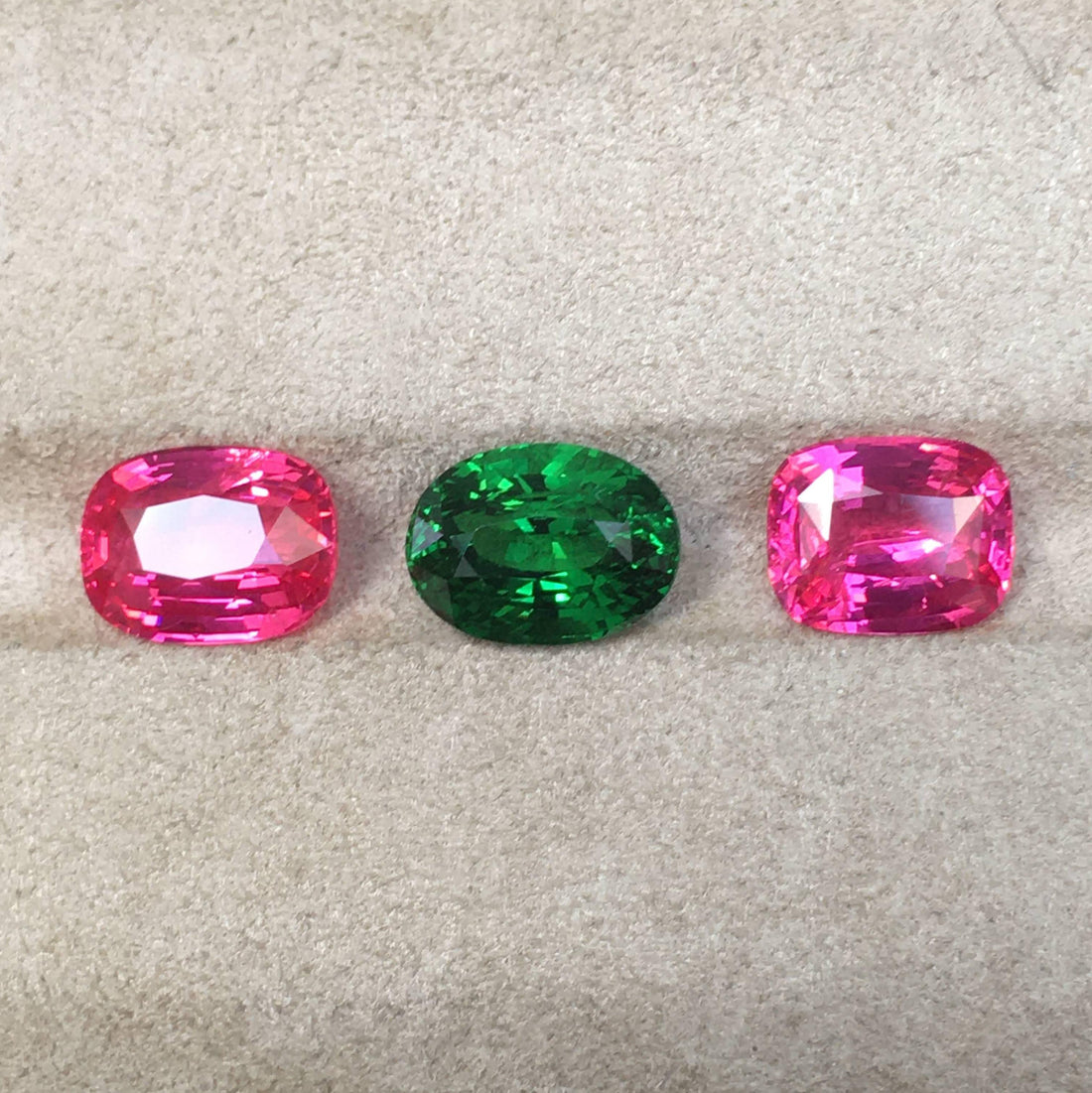
Garnet is a family of related minerals, not a single stone. The most famous variety is red pyrope and almandine garnet, but the family also includes Tsavorite (green, coloured by vanadium — rivalling fine emerald) and Demantoid garnet (green, with exceptional dispersion). Fine Tsavorite and Demantoid are among the rarest stones in the world.
TANZANITE — MOHS 6.5
Tanzanite is found in a single geological area in northern Tanzania — making it roughly 1,000 times rarer than diamond by geographic source. Its deep blue-violet colour shifts between blue and purple depending on the angle of light. At Mohs 6.5, it’s softer than ideal for rings but exceptional in earrings and pendants.
| Gemstone | Mohs | Colours | Best For |
|---|---|---|---|
| Chrysoberyl / Alexandrite | 8.5 | Yellow-green, colour-change | Rings, any jewellery |
| Spinel | 8 | Blue, red, pink, grey | Rings, any jewellery |
| Tourmaline | 7–7.5 | Every colour | Rings, earrings, pendants |
| Garnet | 6.5–7.5 | Red, green, orange, purple | Rings, earrings, pendants |
| Tanzanite | 6.5 | Blue-violet | Earrings, pendants |
| Moonstone | 6–6.5 | White, peach, grey | Earrings, pendants |
| Opal | 5.5–6.5 | Multicolour play of colour | Earrings, pendants |
Why “precious vs semi-precious” doesn’t reflect value
The classification system was built at a time when gemological science was limited and trade needed simple categories buyers could understand. It no longer reflects how professional gemologists, auction houses, or serious collectors evaluate gemstones. Here’s why:
A fine padparadscha sapphire (technically “precious”) can cost less than a fine alexandrite (technically “semi-precious”). A low-quality diamond costs less than an exceptional Tsavorite garnet. The category tells you the stone’s name — not its value, rarity, or beauty.
What actually determines a gemstone’s value is a combination of factors that the precious/semi-precious classification ignores entirely: colour saturation and tone, clarity and inclusion type, cut quality, carat weight, treatment history, and crucially — geographic origin.
A Ceylon ruby carries a significant premium over a Mozambique ruby of comparable quality. A Kashmir sapphire commands multiples of a Madagascar sapphire. Origin matters — and it’s a dimension the traditional classification system never captured.
Ceylon gemstones: precious and semi-precious from one island
Sri Lanka — known in the gemstone trade as Ceylon — produces both precious and semi-precious gemstones of world-class quality. What makes Ceylon remarkable is the sheer variety: precious stones (sapphires, rubies) and some of the world’s finest “semi-precious” stones (chrysoberyl, alexandrite, spinel, cat’s eye) all come from the same geological formations.
The distinction matters most in what you’re buying for. Ceylon sapphires at Mohs 9 are the ideal choice for engagement rings — combining exceptional hardness with vivid natural colour. Ceylon chrysoberyl and spinel, while “semi-precious” by name, are outstanding for ring settings as well. The Mohs hardness of a stone is a more useful guide to durability than its classification category.
Every gemstone we use — whether a Blue Ceylon sapphire or a cobalt spinel — is sourced with full provenance and comes with third-party certification. You can explore the full range of gemstone colours we work with to see your options.
Looking for a certified Ceylon gemstone?
We work with both precious and fine semi-precious stones sourced directly in Sri Lanka. Tell us what you have in mind and we’ll guide you through the options.
💬 Chat with Us on WhatsAppHow to choose a gemstone: what actually matters
Whether you’re choosing a gemstone for an engagement ring, a pendant, or any other piece, the precious/semi-precious label should be one of the last things on your list. Here’s a more useful framework:
1. HARDNESS AND DURABILITY
For rings worn every day, Mohs 8 or above is the practical minimum. Mohs 9+ (sapphire, ruby) is ideal. The Mohs hardness scale tells you far more about a stone’s suitability for daily wear than its classification category does.
2. COLOUR
Colour is the primary value driver for coloured gemstones — more than size or even clarity. A vivid, well-saturated colour with good tone will hold value and beauty over time. Our gemstone colours guide covers the full spectrum of options and what each colour signifies.
3. CERTIFICATION
For any significant gemstone purchase — precious or semi-precious — third-party certification from a recognised lab confirms identity, origin, treatment status, and quality. We include certification with every centre stone we supply.
4. ORIGIN
Where a gemstone comes from affects both its quality characteristics and its market value. Ceylon origin is recognised internationally as a quality marker for sapphires, rubies, chrysoberyl, and spinel. Origin is typically noted on the gemstone certificate.
Frequently asked questions about precious and semi-precious stones
What are the four precious stones?
By the traditional definition used in gemology and the jewellery trade, the four precious gemstones are diamond, ruby, sapphire, and emerald. These four were historically designated as precious based on their rarity, hardness, and cultural significance. All other gemstones are typically classified as semi-precious, though this distinction is considered outdated by most modern gemologists.
What is a semi-precious stone?
A semi-precious stone is any gemstone that does not fall into the four “precious” categories (diamond, ruby, sapphire, emerald). Semi-precious stones include hundreds of minerals — from widely available varieties like amethyst and citrine to genuinely rare and valuable stones like alexandrite, Paraíba tourmaline, and Tsavorite garnet. The label says nothing about the actual rarity or value of a specific stone.
Is sapphire a precious or semi-precious stone?
Sapphire is classified as a precious stone — one of the traditional Big Four alongside diamond, ruby, and emerald. It’s a variety of the mineral corundum (aluminium oxide) rated Mohs 9, making it one of the hardest and most durable gemstones for jewellery. Ceylon sapphires from Sri Lanka are particularly prized for their velvety blues and exceptional clarity.
Is a semi-precious stone less valuable than a precious stone?
Not necessarily. The terms “precious” and “semi-precious” don’t directly indicate value. A fine alexandrite (semi-precious) can cost more per carat than a low-quality diamond (precious). Value depends on a stone’s colour, clarity, size, origin, and rarity — not its classification. Alexandrite, Paraíba tourmaline, and fine Tsavorite garnet are all semi-precious by name yet command premium prices in the market.
What types of precious stones does Sri Lanka produce?
Sri Lanka (historically known as Ceylon in the gemstone trade) produces both precious and semi-precious gemstones of world-class quality. Precious stones include Ceylon sapphires (blue, pink, violet, yellow, and white) and Ceylon rubies. Notable semi-precious stones include chrysoberyl, alexandrite, cat’s eye, spinel, and moonstone. Sri Lanka is one of the few places on earth where this range of gem-quality stones is found in a single geological region.
Is ruby the same mineral as sapphire?
Yes. Both ruby and sapphire are varieties of the mineral corundum (aluminium oxide). The difference is colour — red corundum is classified as ruby; all other colours of corundum (blue, pink, violet, yellow, white, orange) are classified as sapphire. Both share the same Mohs 9 hardness and excellent durability for daily wear.
Unsure which gemstone is right for you?
We’ll help you compare options — precious, semi-precious, certified Ceylon origin. Ships locally and internationally.
💬 Chat with Us on WhatsApp